
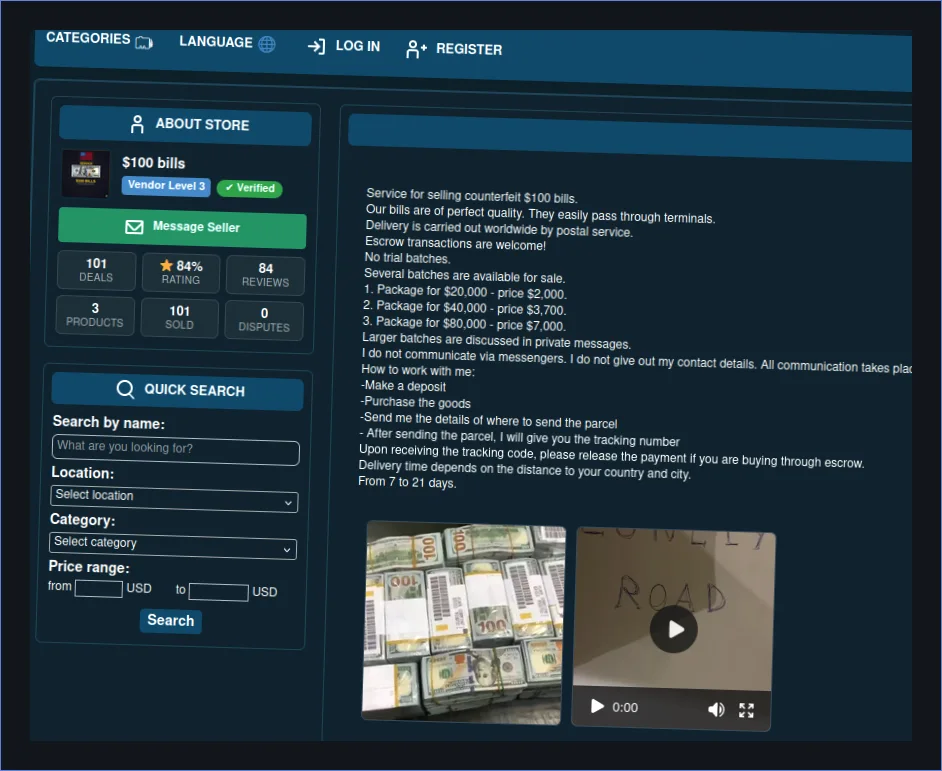
In 2025, 29-year-old Derek H. from Denver came across an interesting opportunity. He invested $1,200 in cryptocurrency to obtain 40 counterfeit $100 bills from a darknet platform. The vendor asserted that these bills, known for their superdollar quality, would easily pass visual checks because of their UV features, magnetic strips, and watermarks. Derek intended to deposit the fraudulent currency into ATMs that accept cash, hoping that the funds would be credited to his account prior to a digital transfer. However, while the first two ATMs worked as expected, the outcomes from the third and fourth machines were disappointing.
Quick summary
- 40 identical counterfeit $100 bills triggered a bank’s fraud detection instantly.
- ATMs accept fake money, but banks cross-check serial numbers later.
- Darknet sellers overpromise on undetectable fake dollar bills.
- A $30 per bill fake money dollar price doesn’t ensure success.
- Transaction patterns, not quality, expose most counterfeit schemes.
How did a $1,200 investment in fake money darknet end in arrest?
The first two deposits, amounting to $2,000, proceeded smoothly. The counterfeit $100 bills and fake $20 bills seemed authentic enough for the machines. After these transactions, Derek's account reflected an increase of $800. However, the third ATM declined one of the bills, and the fourth accepted it but flagged the transaction as suspicious.
By the next morning, his bank froze the account. The system had flagged the serial numbers: 40 identical 2009-series notes deposited in quick succession. Banks cross-check serials against databases, and duplicates are a red flag. The Secret Service traced the origin within three weeks. Derek’s mistake wasn’t the quality of the fake money dollar bills—it was the pattern. Realistic fake money Australia or US dollars can pass visually, but banks rely on data, not just appearances.
Why does counterfeit $100 dollar bill pricing not guarantee success?
The fake dollar price Derek paid—$30 per bill—was premium for darknet standards. Sellers often advertise superdollar quality, buy fake dollars, or even buy counterfeit 20 dollar bills as undetectable. Yet, the best forgeries still fail if used carelessly. ATMs may not scrutinize every bill, but banks do. Serial number checks, transaction timing, and deposit volume are all monitored. A single fake 100 dollar note might slip through, but 40 identical ones will not. The darknet marketplace itself may be anonymous, but the trail of deposits isn’t. Derek’s case proves that even the most realistic fake money can’t outsmart the system’s algorithms.
The lesson: prop money dollars fail where data succeeds
Derek’s story is a cautionary tale for those browsing darknet marketplaces for fake money dollars. A high fake money darknet price and quality claims mean little against automated bank safeguards. The website where the purchase was made promised anonymity, but the execution did not.
Further services. We keep a short list of services we check regularly. Tor mirrors